


Best Throw Pillows for Couch: The Best Throw Pillows for


You bought the sofa. You found the rug. Maybe you even added a lamp and a coffee table. But the room still feels a little unfinished.
That’s where throw pillows come in. They’re often the detail that turns a couch from “good enough” into a spot that feels inviting, personal, and pulled together. The best throw pillows for couch styling don’t just add color. They soften hard lines, make seating more comfortable, and help the whole room feel intentional.
A lot of people get stuck here. They stand in front of a screen or in a store, staring at dozens of pillow options, and every choice starts to look the same. Square or lumbar. Linen or velvet. Two pillows or five. Neutral or bold. It’s easy to overthink.
The good news is that pillow styling is much simpler once you break it into a few clear choices. Start with size. Then think about fill, fabric, color, and arrangement. When each part makes sense, the whole look comes together naturally.
The Finishing Touch Your Living Room is Missing
A living room can be beautifully furnished and still feel flat.
I see this most often in spaces that have the big pieces right. The sofa fits the room. The rug anchors the seating area. The side tables work. But the couch still looks bare, or worse, a little stiff. Without something soft to bridge comfort and style, the room can feel like it’s missing its last layer.
Throw pillows do that job better than almost anything else. They’re the jewelry of the living room, but they’re useful jewelry. They support your back during movie night, make a loveseat feel more welcoming, and give you a simple way to reflect your taste without replacing major furniture.
A classic rolled-arm sofa, for example, often needs pillows that soften its structure. A sleek low-profile couch can use texture to keep it from feeling cold. A sectional usually needs a few well-placed accents so the large shape feels warm instead of heavy.
A couch without pillows isn’t always incomplete, but it often looks less lived-in than the rest of the room deserves.
What makes this tricky is that pillows seem small, yet they have a big visual effect. One wrong choice can make a sofa feel crowded. The right combination can make the same couch look custom-styled.
If your room feels almost right, this is often the missing step.
For more inspiration on how pillows work with sofas, rugs, and accent pieces, browse these stylish living room furniture ideas.
Start with Structure Pillow Size and Fill
Most pillow mistakes happen before color even enters the picture. The issue is usually structure.
A pillow can have a beautiful pattern and still look wrong if it’s too big, too flat, or too small for the couch underneath it. That’s why the best throw pillows for couch styling start with size and fill first, then move into the fun decorative choices.
Why generic sizing advice falls short
A lot of pillow guides treat every sofa the same. But this discussion of throw pillow sizing gaps points out that many recommendations focus on generic square pillows and don’t really address apartment sofas, compact seating, or sectionals.
That matters because scale changes everything.
A pillow that looks perfect on a deep three-seater can overwhelm a compact loveseat. A sectional with a chaise may need a different mix than a straight sofa because the eye reads that shape differently. Curved arms, low backs, and tight seats all affect what feels balanced.
Here’s an easy way to approach it:
- Compact couch. Keep the arrangement lighter and avoid oversized pillows that eat up sitting room.
- Standard sofa. You have room to layer sizes without making the couch feel fussy.
- Large sectional. Use enough visual weight to match the scale, especially near corners.
If you’re still choosing seating, this guide on what to look for when buying a sofa helps you evaluate shape, depth, and proportion before you style anything.
Fill changes how a pillow lives
Two pillows can be the same size on the label and look completely different because the insert isn’t the same.
Some fills feel relaxed and sink-in soft. Others look fuller and hold a crisp shape. Neither is automatically better. The best one depends on how you use your couch.
| Fill type | Best for | What it feels like |
|---|---|---|
| Down or feather blend | Formal but cozy living rooms | Soft, relaxed, easy to fluff |
| Down-alternative | Allergy-conscious homes | Plush with a cleaner, more uniform shape |
| Poly-fill | Budget-friendly refreshes | Lightweight, simple, easy to replace |
A few practical guidelines help:
- For everyday lounging choose a fill that bounces back without looking stiff.
- For a crisp, structured appearance pick inserts that keep corners full and prevent drooping.
- For family rooms removable covers matter just as much as the insert.
Practical rule: If your pillows look limp within minutes of setting them down, the issue is usually the insert, not the cover.
Good structure gives you the foundation. Once that’s right, fabric becomes much easier to choose.
Add Personality with Fabric and Texture
Fabric is where pillows start to feel personal.
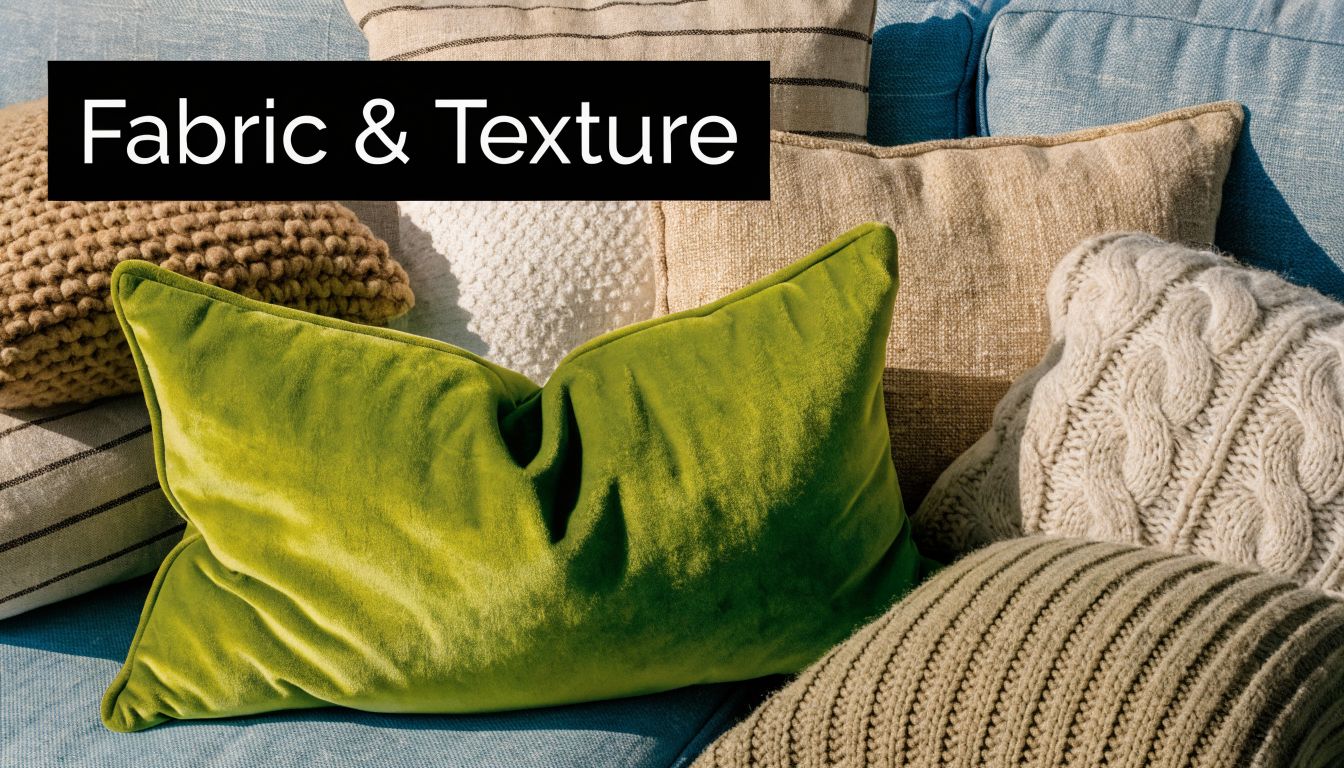
You can put the same shape on the same couch in two different fabrics and end up with two completely different moods. Linen feels easy and relaxed. Cotton feels familiar and versatile. Velvet reads dressier. Chunky weaves bring warmth. Smooth woven fabrics feel cleaner and more structured.
The trick is not choosing the fanciest fabric. It’s choosing one that fits the way you live.

The easiest fabrics to live with
If you want pillows that look good and feel comfortable through daily use, linen and cotton are strong choices. According to this review of the best fabric for throw pillows, linen and cotton stand out for breathability, with MOI greater than 0.4 compared with synthetics at 0.2 to 0.3, and they offer 15 to 20 percent better moisture wicking and temperature regulation. The same source notes that both fabrics can withstand 500+ wash cycles at 40°C with less than 5 percent shrinkage when pre-washed, which makes them especially practical for everyday homes.
That’s a lot of science for a small decorating choice, but the takeaway is simple. Natural fibers usually feel better to sit against, especially in family rooms where people use the couch every day.
They also tend to suit a wide range of styles:
- Cotton works almost anywhere and plays well with prints, stripes, and solids.
- Linen brings a softer, more casual texture that helps a room feel relaxed.
- Velvet adds richness, but it usually asks for a little more care.
- Nubby or woven textures add depth even when the color stays neutral.
Match texture to your lifestyle
Some readers want a polished sofa for entertaining. Others need something that survives snack time, pets, and weekend naps. Most homes need a little of both.
If you have kids, pets, or frequent guests, look for removable covers and fabrics that don’t show every fingerprint or stray hair. If your couch sits in a sunny room, choose materials that still look handsome when the light hits them all afternoon.
A simple mix often works best:
- One smooth fabric to keep the arrangement grounded
- One textured fabric to add depth
- One accent fabric or pattern to keep the look from feeling flat
A pillow arrangement gets interesting when the textures differ, even if the colors stay quiet.
You don’t need five dramatic fabrics fighting for attention. One linen pillow, one soft cotton print, and one textured neutral can do more for a couch than a pile of flashy covers that don’t relate to each other.
Create Harmony with a Cohesive Color Palette
Color is where many people freeze.
They aren’t sure whether the pillows should match the sofa, contrast with it, or pull from the rug. So they either buy everything in one safe shade or mix so many tones that the couch starts to look accidental.
A better approach is to treat pillows the way you’d build an outfit. You need a base, a supporting shade, and a little personality.

Three color paths that rarely fail
The easiest palettes usually fall into one of these directions:
Monochromatic
Choose several shades of one color family. On a beige sofa, that might mean ivory, oat, camel, and soft brown. This gives you a calm, layered result.Analogous
Use colors that sit near each other visually, such as blue, blue-green, and green. This feels collected without being loud.Complementary
Add contrast with opposites, such as blue with rust-toned accents or green with warm clay shades. This creates more energy in the room.
If you’d like help seeing how these schemes translate into real rooms, this expert guide to the perfect color palette is a helpful next step.
Pull from what you already own
You don’t have to invent a palette from scratch. Your room already gives you clues.
Look at these pieces first:
- Your rug often holds the best mix of anchor colors and accents.
- Wall art can suggest one or two stronger shades for a focal pillow.
- Curtains and upholstery help you decide whether the room leans warm or cool.
- Wood tones and metals tell you whether crisp contrast or softer blending will feel more natural.
A few examples make this easier.
| Couch color | Safe palette | Bolder palette |
|---|---|---|
| Gray | Cream, slate, soft blue | Mustard, navy, rust |
| Beige | Ivory, taupe, olive | Terracotta, indigo, charcoal |
| Navy | Blue-gray, cream, sand | Blush, ochre, patterned neutrals |
Keep one color quiet
Most pillow arrangements look better when one part of the palette stays calm. If every pillow is trying to be the star, the eye doesn’t know where to land.
Choose one main family, one supporting tone, and one accent. That’s usually enough to make a couch feel styled without making it feel busy.
This is especially helpful if you’re decorating a compact room. Strong color can still work beautifully, but it needs breathing room around it.
Master the Art of Arrangement for Any Couch
Once size, fill, fabric, and color make sense, arrangement becomes much less intimidating.
People often go too far. They buy a stack of attractive pillows, line them across the sofa, and then realize no one can sit down comfortably. Good styling has to leave room for real life.
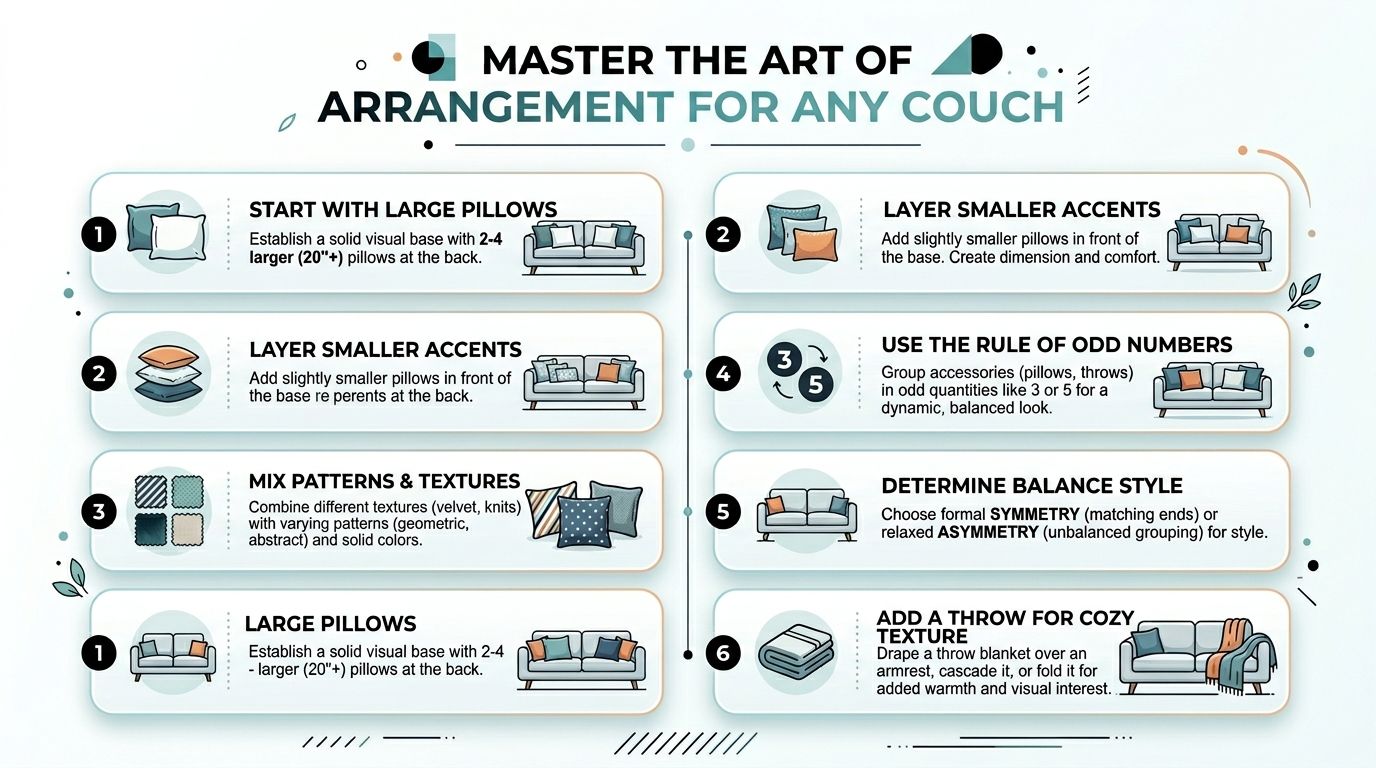
Design experts widely recommend using odd numbers of throw pillows, especially 3, 5, or 7, and for many homes that’s the simplest rule to follow. A standard two-seater sofa uses 3 pillows, a larger three-seater uses 5, and sectionals can handle 5 to 7. The same guidance notes that 68% of homeowners cite over-pillow clutter as a top decor frustration, which is why restraint matters as much as style in these throw pillow sizing recommendations.
The compact loveseat recipe
A loveseat needs discipline. There isn’t much extra room, so bulky layers can make the whole piece feel swallowed.
For a standard two-seater, the cleanest recipe is 3 pillows. The classic setup uses two matching larger pillows at the ends and one smaller accent pillow layered in front. That arrangement feels balanced, but it still leaves room to sit.
Try this if your loveseat anchors a smaller living room:
- Back corners with two larger matching pillows
- Front layer with one smaller accent in a different texture or pattern
- Keep the center open so the couch still feels usable
This works beautifully on apartment sofas, condo seating, and smaller classic loveseats.
The classic three-seater recipe
A full-size sofa usually benefits from more layering, but it still needs order.
For a larger three-seater, 5 pillows creates a composed look. A pair on each side builds the frame, and a single center pillow keeps the arrangement from looking too rigid. That middle piece is a great place for a lumbar shape or a subtle accent fabric.
A practical formula looks like this:
| Position | Suggested role |
|---|---|
| Outer left | Largest anchor pillow |
| Inner left | Slightly smaller coordinating pillow |
| Center | Lumbar or accent |
| Inner right | Match the left side |
| Outer right | Match the left anchor |
This arrangement suits many couch styles, especially rolled-arm sofas, tuxedo sofas, and transitional three-cushion seating.
For more visual furniture layout ideas beyond pillows, these living room arrangement ideas can help you pull the whole seating area together.
The sectional recipe that stays inviting
Sectionals need enough softness to match their size, but they can turn cluttered fast if every corner gets stuffed.
A good range is 5 to 7 pillows. The key is to treat the sectional as zones instead of decorating every seat. Focus first on the far ends and the inside corner. Then stop and assess before adding more.
Use this approach:
- Start at both ends with your largest supportive pillows
- Add depth at the corner where the sectional changes direction
- Use one or two accents to break repetition
- Leave open seating areas for the spots people use most
More pillows don’t automatically make a sectional look luxurious. The arrangement looks better when the couch still invites someone to sit down.
A quick note on pet-friendly and kid-friendly styling
If your couch is the family hub, your arrangement should work hard.
Choose pillows you won’t mind moving aside. Mix in washable covers. Avoid delicate trims if pets scratch or kids tug. And keep the most precious fabrics for the seats no one uses every hour of the day.
The best throw pillows for couch styling aren’t just attractive. They fit the habits of the room.
Protect Your Investment with Proper Care
A beautiful pillow that can’t survive daily life won’t stay beautiful for long.
That’s why care matters just as much as style. If you’ve chosen good structure and practical fabric, maintenance doesn’t have to be difficult. It just needs to be consistent.
Read the cover before you clean
Start with the care label on the pillow cover, not your best guess.
Some covers can go right into the wash. Others should be spot-cleaned. Textured weaves, trims, and dressier fabrics often need a gentler hand than everyday cotton or pre-washed linen. If the cover is removable, take it off before cleaning so you’re treating the fabric and insert properly.
A simple routine helps:
- Vacuum lightly with a brush attachment to remove dust and pet hair
- Spot-clean quickly when spills happen so stains don’t set
- Wash removable covers according to their label instead of using one setting for everything
- Air out inserts now and then to keep them feeling fresh
Fluffing is part of the job
Pillows compress because people use them. That’s normal.
What keeps them looking good is regular fluffing and reshaping. If you leave them flattened day after day, even a nice pillow starts to look tired. A quick plump in the morning or after guests leave is more effective than often assumed.
Good pillows age better when you reshape them often instead of waiting until they look worn out.
If a pillow cover still looks great but the inside feels lifeless, replace the insert before replacing the whole pillow. That one move can bring a favorite accent back to life.
Save delicate styles for lower-traffic rooms
Not every pillow has to be built for chaos.
You might keep machine-washable cottons and textured neutrals on the main family sofa, then use more delicate fabrics in a formal sitting room or on an accent chair that gets lighter use. That mix often feels smarter than expecting every pillow in the house to do the same job.
When people feel disappointed in their pillows, it usually comes down to a mismatch. The fabric was too precious for the room, or the insert was too flimsy for everyday use. Choose with maintenance in mind, and the whole arrangement lasts longer and looks better while doing it.
Your Perfect Living Room Awaits at Short Furniture
Choosing pillows gets easier when you stop looking for one magical answer and start building from a few reliable decisions.
Pick a size that fits your couch. Choose a fill that matches how you lounge. Select fabric based on comfort and maintenance. Pull your colors from the room you already have. Then arrange the pillows in a way that looks polished without taking over the seating.
That’s the formula.
If you’ve been searching for the best throw pillows for couch updates, you probably don’t need more inspiration. You need options that are easy to shop, guidance you can trust, and a team that understands how real families live. That’s where Short Furniture stands apart.
Since 1870, Short Furniture has helped Illinois families furnish their homes with quality pieces that feel both stylish and practical. Whether you’re refreshing one sofa with new accents or redesigning a whole room with living room sets, accent chairs, rugs, dining tables, bedroom furniture, or mattresses, you can shop with the confidence that comes from a long-standing family business.
A few things make the experience easier:
- Complimentary design consultations help you narrow down colors, shapes, and pairings without guesswork.
- Reliable delivery means your furniture and home accents arrive with the care your home deserves.
- Flexible financing options make it easier to invest in pieces you’ll enjoy now instead of waiting.
- A wide online selection gives you room to compare styles, materials, and brands from home.
If you’re an overwhelmed decorator, you don’t have to figure it all out alone. If you’re a quick room refresher who knows what you like, you can browse and order online with ease. And if you’re furnishing a larger space, it’s helpful to have one trusted place where sofas, sectionals, occasional tables, mattresses, and decor can all work together.
The right pillows can change the mood of a room in an afternoon. The right furniture partner can help you create a home that feels complete for years.
Shop Short Furniture to browse pillow-friendly sofas, stylish home decor, and fresh arrivals for every room. If you’d like expert help, schedule your complimentary design consultation, explore flexible financing options, and apply for financing today so you can bring your living room together with confidence.