


How Long Should a Good Mattress Last? Find Out Here

You go to bed tired, sleep through the night, and still wake up feeling wrung out. Your shoulder is stiff. Your lower back complains when you swing your feet to the floor. You might blame stress, age, or a bad pillow first. But many families find the actual problem is much closer. It’s the mattress they’ve been sleeping on for years.
That can be frustrating because mattresses aren’t small purchases. Consumers want to buy one, use it well, and feel confident they made a smart decision. They also want a simple answer to a very common question: how long should a good mattress last?
The honest answer is that a mattress doesn’t expire on one exact date. Its useful life depends on what it’s made of, how well it was built, and how it’s been used at home. A guest room bed ages differently than the one two adults sleep on every night. A high-quality latex mattress won’t wear the same way as a basic innerspring. And a long warranty doesn’t always mean long-lasting comfort.
Your Partner in Rest Since 1870
A bad mattress rarely announces itself all at once. More often, the change is gradual. You notice you’re rolling into the same spot each night. You start sleeping better in a hotel or guest room than in your own bed. Then one morning, you wake up and realize the bed that once felt comfortable now feels like work.

For a family furniture business, those stories sound familiar. Generations of customers have walked in with the same concern. They aren’t looking for a trendy pitch. They want straight answers, durable choices, and the confidence that they’re buying something that will serve their household well.
That’s why experience matters. A company with deep roots sees patterns over time. It knows that one sleeper may need pressure relief, another may need firmer support, and both need realistic expectations about how long a mattress can stay comfortable. Heritage matters too, especially when you’re making a purchase tied so closely to health, comfort, and everyday life. You can learn more about that long-standing background on the Short Furniture family story.
A mattress is one of the few pieces in your home that affects you before your day starts and after it ends.
A strong mattress decision also fits into the bigger home picture. The bed frame underneath matters. So does the rest of the bedroom setup. Families often think about sleep first, then realize they also want a more functional space with coordinated bedroom furniture, better storage, or even updates in nearby rooms like a guest bedroom, living room, or dining area.
When you understand mattress longevity, you shop differently. You stop focusing only on the sticker price. You start asking better questions. How long will it stay supportive? What materials hold up best? What will this bed really cost me over the years I use it?
Those are the questions that lead to better rest.
The 7-Year Itch Is It Time to Switch
You wake up with a stiff back, shift to the edge of the bed to put on your slippers, and notice the spot where you sleep feels lower than the rest. That is often the moment a family starts asking the right question. Not just, “How old is this mattress?” but “Is this bed still giving us the support we paid for?”
A mattress does not wear out all at once. It ages more like a favorite sofa cushion or a pair of work boots. The shape changes slowly, the comfort fades a little at a time, and your body starts doing extra work to compensate. The National Sleep Foundation’s guidance on mattress replacement is a useful starting point. Many mattresses are best replaced somewhere around the 7 to 10 year mark, depending on how they were built and how they have been used.
That range gives you a benchmark, not a deadline stamped in stone.
Build quality matters. Daily use matters. A guest room mattress and the bed two adults use every night will not age the same way, even if they came home on the same delivery truck. Heavier body weight, an adjustable base, kids piling in for Saturday morning cartoons, and softer comfort materials can all change how quickly a mattress loses its original feel.
The practical question is whether the mattress still holds your body in healthy alignment and relieves pressure the way it did when it was new. Age helps you narrow the answer, but comfort and support tell the real story.
A simple rule helps:
- A newer mattress can still wear out early if the materials are lower quality.
- An older mattress can still feel good if the construction is stronger and the use has been lighter.
- Your body’s feedback each morning matters as much as the calendar.
If you want a quick way to judge where your bed stands, this guide on how old your mattress is and what that means can help you compare age with real-world performance.
The money side matters too, and it gets overlooked in a lot of mattress advice. Families often focus on sticker price because it is the easiest number to see. The better number is cost per night.
A mattress that costs more up front but stays comfortable for years can cost less per night than a cheaper model that sags early and needs replacing sooner. Put another way, a mattress is not just a purchase. It is a long-term household tool you use every single night. If better construction gives you more years of support, fewer restless nights, and less morning soreness, the total cost of ownership starts to look very different.
That is one reason shoppers who buy from a trusted local retailer often make steadier decisions. You are not only comparing prices. You are comparing how long the comfort is likely to last, how the materials typically hold up, and what your family will get for the money over time.
Keep the 7 to 10 year range in mind. Then look closer. The true value of a mattress comes from how well it supports your sleep night after night, and what that means for your budget and your well-being over the years.
Mattress Lifespan by Type A Detailed Comparison
A mattress tag may list fancy materials and trademarked names, but lifespan usually comes down to a simpler question. What is doing the support work each night, and how well will those materials hold their shape after years of use?
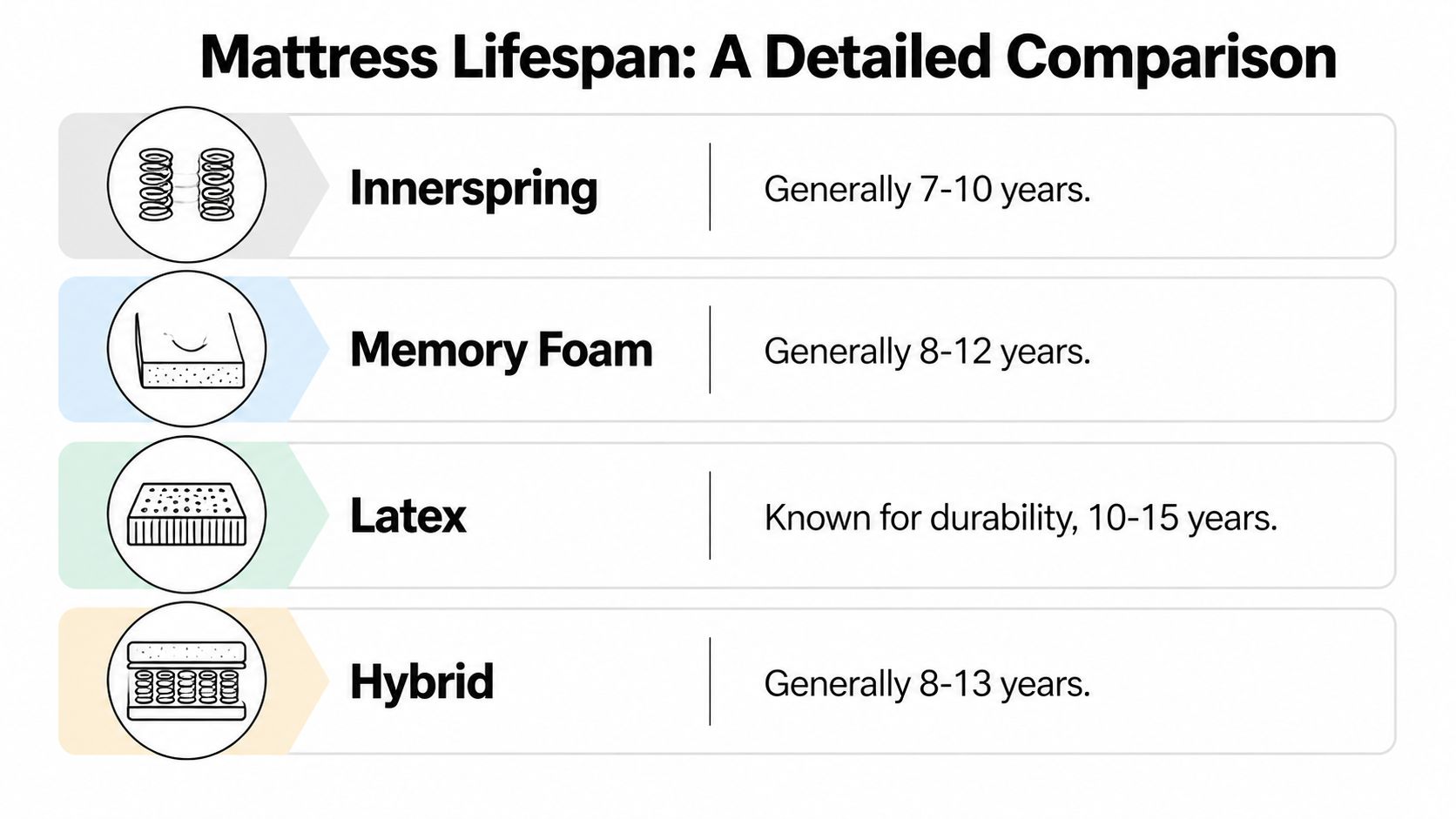
In our family furniture business, we have seen this pattern for generations. Two beds can feel similar in a showroom for ten minutes and age very differently in a home after five years. That is why mattress type matters. It shapes both comfort life and cost per night.
Innerspring mattresses
An innerspring mattress relies on coils for support, with softer comfort materials layered on top. It is the classic mattress design many people grew up with, so the feel is familiar right away.
As noted earlier, innerspring models usually sit on the shorter end of the lifespan range. The springs may keep working for a while, but the upper comfort layers often show wear first. That is usually what people notice. A mattress can still look fine from across the room and feel tired once you lie down.
Common wear points include:
- Coil fatigue: Springs gradually lose some of their pushback.
- Compressed top layers: Pillow tops and plush foams can flatten before the support core gives out.
- More noticeable motion: As materials age, movement from one sleeper can become easier to feel.
For a guest room, child’s room, or a lower upfront budget, innerspring can still be a sound choice. Just view it as a lower entry price, not automatically the lowest long-term cost.
Memory foam mattresses
Memory foam is popular because it cushions pressure points and molds more closely to the body. Side sleepers often like that hugged, slower-response feel.
The detail that separates a mattress that holds up from one that softens too soon is usually foam quality. Sleepbasil’s breakdown of mattress lifespan and foam density explains that density is one of the clearest indicators of how long foam comfort tends to last. In plain English, better foam usually keeps its shape longer.
That helps explain a common shopper frustration. Two foam mattresses can look nearly identical online, carry similar descriptions, and have very different staying power in a real bedroom.
A simple comparison helps:
| Mattress type | What tends to affect lifespan most | Typical durability direction |
|---|---|---|
| Innerspring | Coil quality and top-layer wear | Shorter end |
| Memory foam | Foam quality and density | Wide range |
| Latex | Material quality, especially natural latex | Longer end |
| Hybrid | Quality of both foam and coil systems | Middle to strong |
If you are shopping foam, ask what is inside the mattress, not just how it feels on day one.
Latex mattresses
Latex has a strong reputation for durability, and in many homes, it earns it. It is springy, supportive, and generally better at keeping its structure over time than softer, lower-grade comfort materials.
Natural latex is usually the standout. It tends to hold up well, which is why buyers who plan to keep a mattress for the long haul often start here. The upfront price is higher, but the math can work in your favor. If a mattress stays comfortable for more years, the cost per night often drops, even if the ticket price was harder to swallow at first.
Families who choose latex are often looking for three things:
- Support that stays steadier over time
- A buoyant feel with less sink than memory foam
- Better long-term ownership value
This is the mattress category that often makes the most sense for shoppers who think in decades, not promotions.
Hybrid mattresses
Hybrid mattresses combine two systems. You get coils underneath for support and foam or similar comfort layers above for pressure relief. For many couples and combination sleepers, that balance feels more natural than an all-foam or traditional innerspring bed.
The trade-off is straightforward. A hybrid is only as durable as its weakest major component. If the coils are strong but the comfort layers are cheap, the surface may wear out early. If the foam is excellent but the support unit is weak, the mattress can still lose its feel sooner than expected.
If you want a clearer picture of how this construction works, this guide to what a hybrid mattress is breaks it down in plain language.
The best mattress type is the one whose materials, feel, and expected lifespan match how your household actually sleeps.
Which type gives the best value
Value changes depending on the goal.
- Lower upfront cost: often innerspring or basic foam
- Pressure relief and contouring: often memory foam
- Longest expected durability: often latex
- Balanced comfort and support: often hybrid
That is where cost per night becomes useful. A less expensive mattress that needs replacing sooner can cost more over time than a better-built model from a trusted retailer such as Short Furniture. Good mattress shopping is not only about what you spend this month. It is about what your family gets from that bed over thousands of nights.
Clear Signs Your Mattress Is Past Its Prime
A mattress doesn’t need to be ancient to be worn out. Sometimes the clearest answer comes from what your body notices every morning.
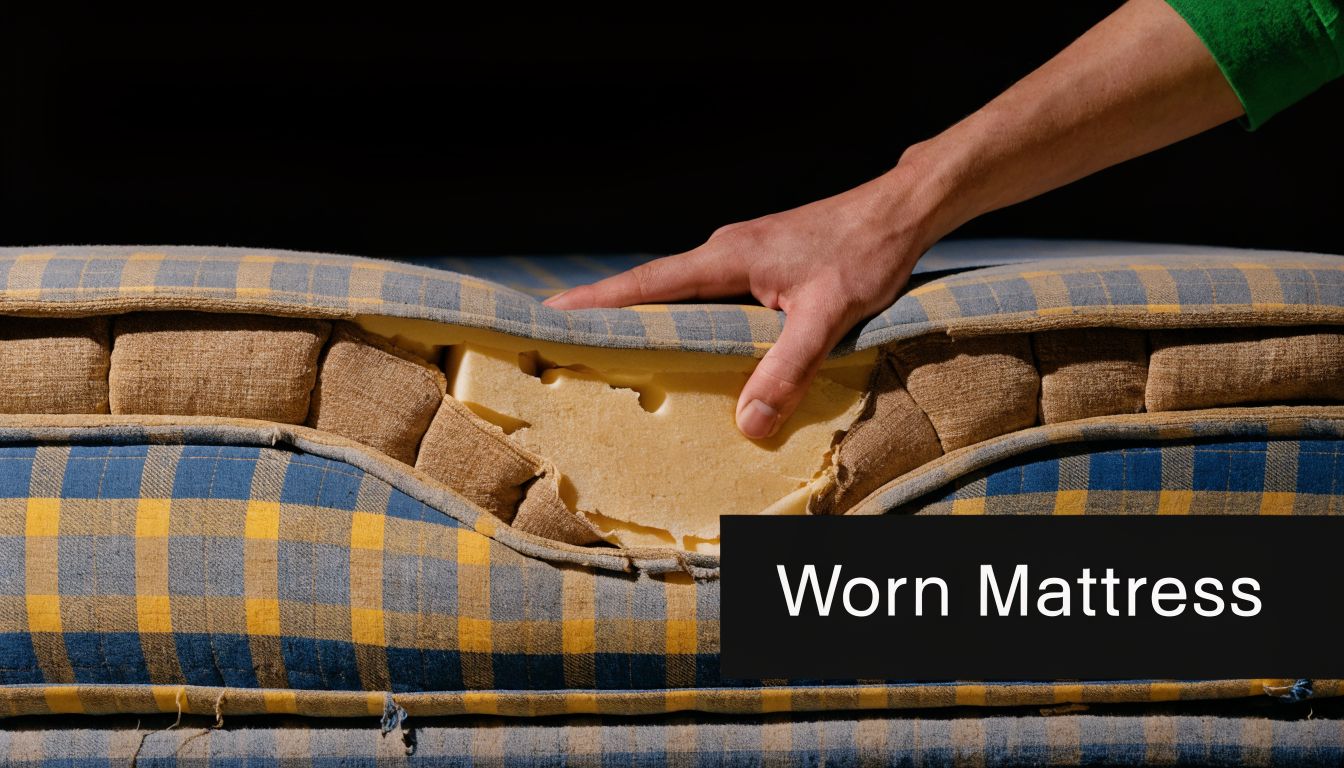
Your body feels the problem first
If you wake up stiff, sore, or tired more often than you used to, don’t brush it off too quickly. A mattress past its prime often stops keeping your spine in a steady, supported position through the night. That can show up as shoulder tension, lower-back discomfort, or a general sense that sleep didn’t do its job.
The important part is the pattern. A single rough night doesn’t mean much. But if you sleep better elsewhere and worse in your own bed, your mattress deserves a hard look.
Visible wear usually confirms it
The surface of the mattress can tell a very honest story. Look for the kind of wear that doesn’t spring back when you get out of bed. Feel for uneven spots. Listen for sounds that weren’t there before.
Here are the signs that most often point to replacement:
- Sagging or body impressions: If you can see dips where you usually sleep, the support layers may have compressed.
- Lumps or uneven firmness: One area feels soft, another feels oddly hard, and your body has to adapt all night.
- Spring noise: Creaking, popping, or groaning can mean an innerspring system is wearing down.
- Edge weakness: Sitting or sleeping near the edge feels unstable when it used to feel secure.
If the mattress looks tired and you feel tired, that combination is usually more telling than the calendar alone.
Sleep quality changes in subtle ways
Not every worn-out mattress has dramatic sagging. Some stop feeling restorative. You toss more. You shift positions more often. You wake up before the alarm and don’t feel refreshed.
That kind of decline can be easy to normalize, especially in busy households. Parents often accept poor sleep as part of the season they’re in. Empty nesters may assume discomfort is just part of getting older. But when the mattress is no longer supporting healthy rest, replacing it can remove one obstacle you’ve been living around for too long.
A few soft signs matter too:
- Allergy irritation seems worse in bed
- You avoid sleeping in the center or one side
- The mattress just feels “flat” compared to before
- You dread bedtime on your own bed but sleep well when traveling
When to get another opinion
Sometimes couples disagree about whether the mattress is still fine. One person adapts. The other feels every dip and pressure point. That’s common.
In that case, a no-pressure expert opinion can help. A design consultation can be useful here, not because mattress shopping needs to be fancy, but because comfort, bed height, bedroom layout, and proper support all work together. The mattress may be the problem. Sometimes the foundation or frame underneath is adding to it.
When your bed stops helping you recover overnight, it’s no longer doing the job you bought it to do.
How to Make Your New Mattress Last Longer
A mattress is one of those purchases that rewards good habits. Once you bring home the right bed, a little routine care can help protect comfort, support, and long-term value.
Start with the basics that matter most
Some maintenance advice sounds optional. This isn’t.
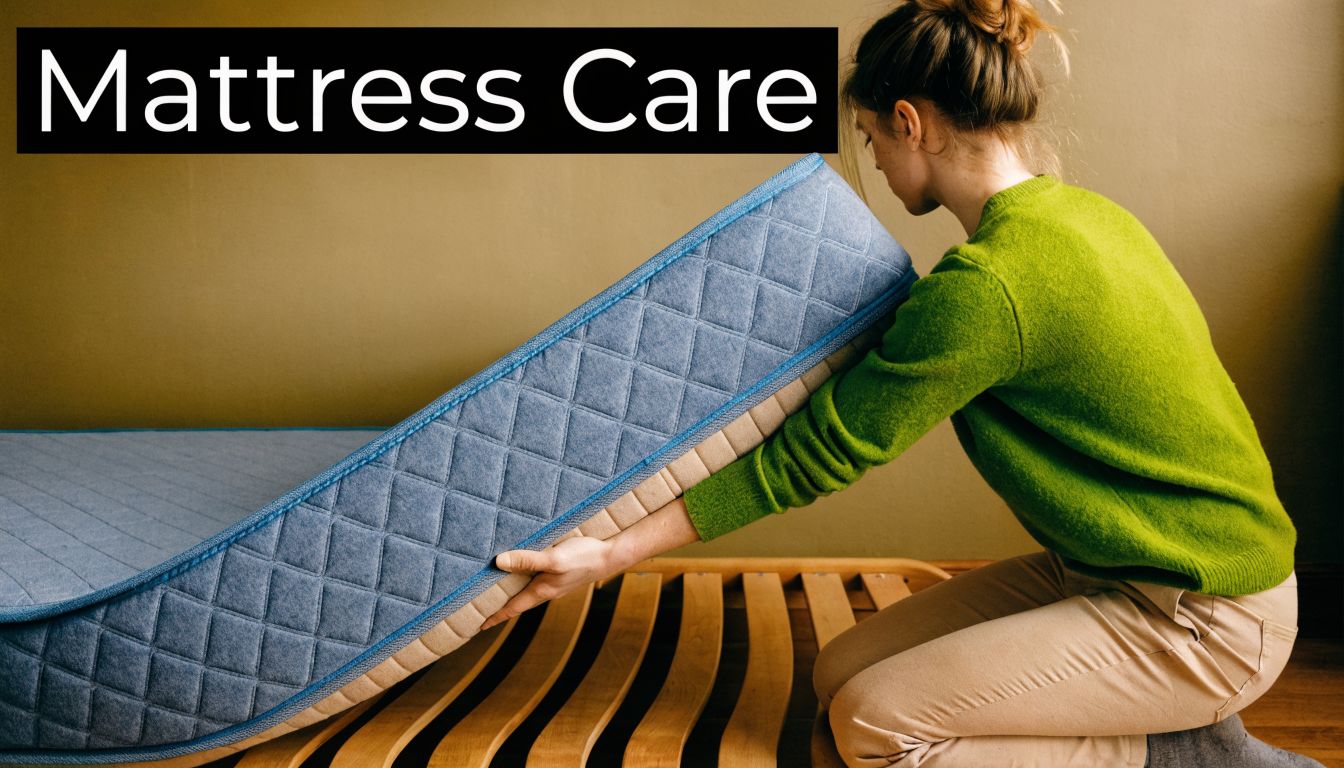
According to Tough Stuff Recycling’s mattress lifespan guide, rotating your mattress every 3 to 6 months and using a quality mattress protector are important for maximizing lifespan. The same source explains that proper care can significantly delay the breakdown of materials and the development of sagging, helping extend comfortable life beyond the average expectancy.
That means maintenance isn’t only about cleanliness. It’s about preserving the feel you paid for.
A practical care checklist:
- Use a mattress protector from day one: Spills, sweat, and daily moisture all work against upholstery and foam.
- Rotate on a schedule: Turning the mattress helps spread wear more evenly across the surface.
- Check your support system: A mattress needs the right foundation, platform, or frame underneath it.
- Keep it clean and dry: A fresh, ventilated sleep environment helps materials stay in better condition.
For more day-to-day guidance, this article on mattress maintenance and cleaning tips to extend lifespan is worth bookmarking.
Protect the whole sleep setup
A mattress doesn’t live alone. It relies on the structure beneath it and the products around it.
If the bed frame is weak, slats are too far apart, or an old base no longer gives proper support, the mattress can wear unevenly. That’s one reason experienced shoppers often replace the mattress and review the foundation at the same time. It’s also why bedroom purchases sometimes connect with the rest of the home. Once people update one part of the room, they often improve nearby pieces too, like nightstands, dressers, or a better reading chair.
Support accessories are worth taking seriously:
- A solid bed frame or platform helps the mattress hold its shape
- A quality protector guards the surface from avoidable damage
- Well-fitted sheets and bedding reduce tugging and bunching that can stress edges over time
Good mattress care is really investment care. You’re protecting years of sleep, not just a product tag.
What not to do
A few habits shorten mattress life faster than people realize.
Don’t let children use the bed like a trampoline. Don’t ignore support issues underneath the mattress. Don’t leave moisture problems unresolved. And don’t assume that because a mattress still looks decent under a fitted sheet, it’s aging well internally.
The goal isn’t perfection. It’s consistency. A simple protector, proper support, regular rotation, and routine cleaning go a long way.
When people think in terms of cost per night, these habits become easy to justify. A little care now helps preserve comfort later. That’s one of the simplest ways to get more value from the mattress you choose.
Understanding Mattress Warranties and Disposal
One of the most confusing parts of mattress shopping is the warranty. Many shoppers see a long warranty and assume it means the mattress will stay comfortable for that entire period. That’s usually not what the warranty means.
Warranty length and comfort life are not the same
According to the Sleep Foundation’s explanation of how long a mattress should last, most mattress warranties often last 10 to 20 years, but they do not cover the gradual loss of comfort and support that comes with normal use. The same source makes the key distinction clear: warranties are generally for manufacturing defects, not for the natural end of a mattress’s usable comfort life.
That’s an important reality check.
A mattress can still be under warranty and still feel worn out to sleep on. If the foam has softened gradually or the support just isn’t what it used to be, that may fall outside warranty coverage. The paperwork may still be active, while your nightly comfort is not.
What a warranty usually helps with
In plain language, warranties are typically meant for problems that point to a defect in how the mattress was made. They are not a promise that you’ll love the feel for every year listed.
A warranty often matters most when there is:
- A manufacturing flaw in materials or workmanship
- A qualifying structural issue
- A problem that meets the brand’s written coverage standards
It usually does not function as a comfort guarantee for ordinary wear.
That’s why savvy shoppers look at both things separately. First, “What protection do I have if something is made wrong?” Second, “How long do I reasonably expect this mattress to feel good in real life?”
Don’t forget the old mattress problem
Replacement has a practical side too. Once you’ve decided the mattress is done, you still have to move it out of your home.
That’s where delivery and removal matter more than many people expect. A mattress isn’t easy to haul down stairs, fit into a vehicle, or dispose of properly on your own. Smooth delivery of a new bed and help with the old one can turn a stressful replacement into a simple household upgrade.
For busy families, older homeowners, and anyone who just wants the process handled well, that convenience is part of the value.
Find Your Perfect Mattress for a Better Tomorrow
A good mattress decision sits at the intersection of comfort, durability, and budget. That’s why the best choice often looks different from one household to the next.
If you want the most value for your budget
A budget-conscious family may do well with a dependable innerspring or a value-oriented foam mattress, especially when the goal is to improve sleep without stretching the household too far. The smart move is to balance today’s price with realistic longevity and proper support underneath. Flexible financing can make that decision easier when you need a better bed now, not months from now.
If you’re upgrading for the long term
Some shoppers want to buy once and buy well. They care less about the lowest opening price and more about long-term ownership value, comfort consistency, and materials that hold up. For that buyer, premium latex or a thoughtfully built hybrid often deserves a close look. The upfront investment can make more sense when the mattress is intended to serve for many years.
If you need a mattress quickly
Sometimes this isn’t a research project. It’s a problem that needs solving right away. Maybe guests are coming. Maybe your current bed has reached the end abruptly. Maybe you can’t bear one more night on it.
In that situation, a broad online mattress selection, reliable delivery, and clear guidance matter a lot. So does having access to someone who can answer practical questions about size, support, and setup without making the process feel complicated.
The right mattress isn’t just the one that feels good in a moment. It’s the one you’ll still be glad you chose after months of real sleep at home.
A better mattress also has ripple effects through the rest of the home. Better sleep makes everything else easier. So if you’re already refreshing a bedroom, it can be a smart time to browse coordinating bedroom furniture, guest room pieces, or even other home updates like living room sets, dining tables, and storage solutions that make daily life run more smoothly.
When you shop with a trusted Illinois furniture retailer, you don’t have to choose between heritage and convenience. You can browse the latest arrivals online, compare mattress types with confidence, explore financing options, and set up dependable delivery without losing the personal guidance that makes a big purchase feel safer.
If you're ready for better rest, explore Short Furniture for quality mattresses, bedroom furniture, living room sets, dining tables, and more. Browse the latest arrivals online, apply for flexible financing today, and ask about reliable delivery and complimentary design consultations to help you choose the right fit for your home and your family.