


How to Choose the Right Mattress Firmness

You wake up after a full night in bed, but your shoulders feel tight, your lower back complains when you stand up, and somehow you’re still tired. It’s often assumed the mattress is “old” or “bad.” Sometimes that’s true. But very often, the bigger issue is that the firmness is wrong for your body.
That’s where mattress shopping gets frustrating. One brand says plush. Another says luxury firm. A third says medium, but it feels nothing like the medium mattress you tried last month. If you’re trying to figure out how to choose the right mattress firmness, the good news is that you don’t need insider jargon. You need a simple way to connect what your body feels at night with what you’re buying.
Families across Illinois have been asking versions of this same question for generations. They want to sleep comfortably, wake up without aches, and feel confident they made a smart purchase. That’s why firmness matters so much. It affects pressure relief, support, and whether your spine stays in a comfortable position while you sleep.
If you’ve been comparing mattresses online, reading reviews, or wondering whether a new bed could help you feel better each morning, this guide will help you sort it out clearly. If you’d like more background on why mattress quality matters in the first place, this piece on investing in a high-quality mattress for your long-term health is a helpful next read.
Your Journey to Better Sleep Starts Here
A mattress can look beautiful in a bedroom and still be wrong for the person sleeping on it.
That happens more often than people think. A side sleeper buys a firm mattress because they’ve heard firm is “better for your back,” then wakes up with sore hips. A stomach sleeper falls in love with a soft, cushy feel in the showroom, then notices nagging lower back strain after a few nights. The comfort issue isn’t always the mattress itself. It’s the match.

Why firmness is the first question to answer
Firmness is the feel of the bed when you lie down on it. It shapes whether your shoulders sink in enough, whether your hips stay lifted, and whether your body feels cradled or held up.
One of the most useful starting points is this: 80% of sleepers prefer a firmness in the 5 to 7 range on the standard 1 to 10 scale, which makes medium-firm the most popular choice according to NapLab’s mattress firmness scale guide. That doesn’t mean everyone should buy the same mattress. It means individuals often find their preference somewhere in the middle, then adjust based on sleep position, body weight, and comfort needs.
Practical rule: If you feel lost, start in the middle. Then move softer or firmer based on how you sleep.
A good mattress should fit your life, not just your room
A mattress isn’t an isolated purchase. It affects how you feel at work, how patient you are with your family, and whether your bedroom feels like a place of recovery or one more source of stress.
That’s also why people often shop for a mattress around the same time they update a bedroom set, refresh a guest room, or redesign a whole home with new living room sets, dining tables, and storage pieces. Better sleep has a way of making the rest of the house feel better too.
If you’re shopping now, stay focused on one simple question: What firmness gives your body the right mix of comfort and support? Once you know that, the rest gets much easier.
Decoding the Mattress Firmness Scale
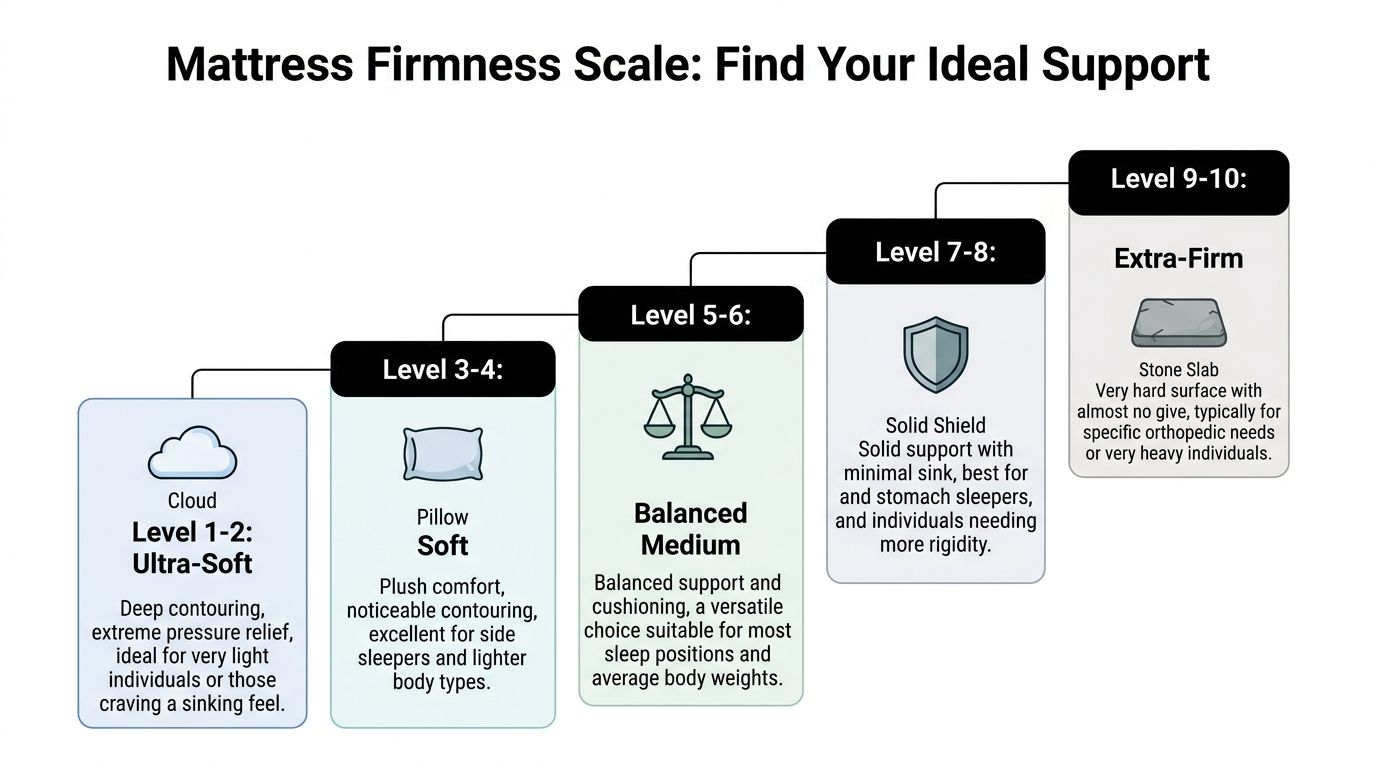
The mattress world uses a 1 to 10 firmness scale. It isn’t perfect, but it’s the clearest common language shoppers have.
Think of it as a feel scale, not a quality scale. A softer mattress isn’t worse. A firmer one isn’t automatically better. The number just tells you how much give you’re likely to feel when you lie down.
What the numbers actually feel like
Here’s a simple way to picture the scale:
| Firmness range | What it feels like | Often works well for |
|---|---|---|
| 1 to 2 | Very plush, lots of sink | Very light sleepers who want deep contouring |
| 3 to 4 | Soft and cushioned | Many side sleepers, especially lighter ones |
| 5 to 6 | Balanced comfort and support | A wide range of sleep styles |
| 7 to 8 | Supportive with less sink | Many back and stomach sleepers |
| 9 to 10 | Very hard with almost no give | Specific needs that call for a very rigid surface |
If you lie down and feel like the mattress is hugging you closely, you’re likely on the softer side. If you feel more “on top” of the mattress than “in” it, you’re moving toward firm.
Why one medium mattress can feel different from another
Shoppers often get confused at this point, and their confusion is understandable.
Two mattresses can both be called medium and still feel different because materials change the sensation. Memory foam often feels slower and more contouring. Innerspring models may feel more buoyant. Hybrids usually combine cushioning with a steadier, more lifted feel.
A quilted pillow top can also make a firmer support system feel gentler at first touch. That’s why labels alone don’t tell the whole story.
A mattress has both a comfort feel and a support feel. People often notice the comfort layer first, then discover the support layer after a full night’s sleep.
Don’t confuse firmness with support
This is one of the biggest mistakes people make.
A mattress can feel soft on top and still support your spine well. A mattress can also feel firm but create pressure at your shoulders and hips. Support is about how well the mattress keeps your body aligned. Firmness is about the surface feel.
If you enjoy the history of how mattresses evolved from simple sleep surfaces to layered modern designs, this look at the history of mattresses from straw mats to memory foam adds helpful context.
A simple way to use the scale while shopping
Use the scale like a starting map:
- If you like cushioning, begin around soft to medium.
- If you want balance, begin around medium to medium-firm.
- If you dislike sinking, begin around firm.
- If you’re comparing models, ask where each one lands on the 1 to 10 range instead of relying only on words like plush or luxury firm.
That one step cuts through a lot of confusion. It gives you a consistent way to compare what you try in a showroom and what you browse online.
Matching Firmness to Your Sleep Style and Body
Your ideal firmness usually comes down to two things. How you sleep and how much of your body presses into the mattress.
That’s why the same mattress can feel wonderful to one person and completely wrong to another.
Start with your main sleep position
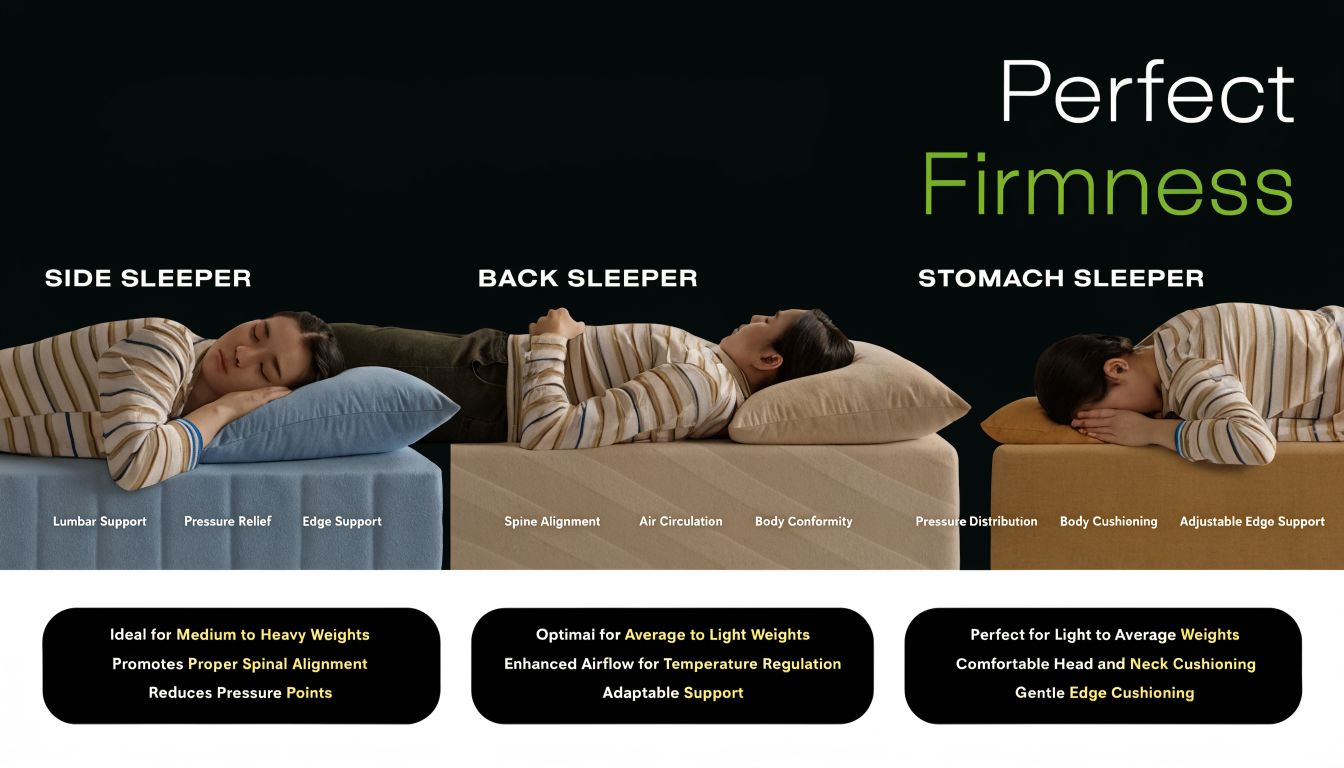
Sleep position tells you where your body needs pressure relief and where it needs support.
Side sleepers
Side sleepers usually need more cushioning at the shoulders and hips.
A mattress that’s too firm can push up into those pressure points. A mattress with a softer to medium feel usually allows enough contouring to keep the body more comfortable.
A good starting range for side sleepers is 4 to 6. If you’re very slight or especially pressure-sensitive, softer may feel better.
Back sleepers
Back sleepers usually need a steadier surface under the hips and lower back.
Too soft, and the hips can dip. Too firm, and the lower back may not get enough contouring. Many back sleepers do well in the 5 to 7 range.
Stomach sleepers
Stomach sleeping typically calls for the firmest feel of the three main positions.
The reason is simple. If the hips sink too far, the lower back can arch uncomfortably. Many stomach sleepers prefer 7 to 9 to keep the midsection better supported.
Combination sleepers
If you rotate between side, back, and stomach positions, look for balance and ease of movement.
Many combination sleepers do well in the middle of the scale, especially on responsive mattresses that don’t make it hard to turn. Hybrids are often a practical option because they combine cushioning with a more lifted feel.
Then adjust for body weight
Body weight changes how much you sink into the mattress. That changes how firm a bed feels.
According to Van Vreede’s mattress firmness guide, those under 140 lbs should consider softer mattresses (3 to 5), while those over 220 lbs often need a firmer mattress (7 to 9) with high-density foam or strong coils to reduce excessive sinkage and maintain support.
Here’s the plain-language version:
Under 140 lbs
You may not sink far enough into a firm bed to get good pressure relief. Softer options often feel more comfortable.140 to 220 lbs
This is the range where many people find medium to medium-firm gives them a strong balance of contouring and support.Over 220 lbs
Softer mattresses can compress more, which may reduce support. Firmer constructions with sturdier materials often work better.
Put those two factors together
The choice then becomes personal.
| Sleep style | Under 140 lbs | 140 to 220 lbs | Over 220 lbs |
|---|---|---|---|
| Side sleeper | Softer side of the range | Medium often works well | Medium-firm or firmer support with pressure relief on top |
| Back sleeper | Medium or medium-soft can feel comfortable | Medium-firm is a common fit | Firm support is often more dependable |
| Stomach sleeper | Medium-firm may be enough | Firm is often safer | Firm to extra firm is often worth trying |
| Combination sleeper | Medium with easy movement | Medium to medium-firm | Medium-firm to firm, especially in a hybrid |
If your mattress feels fine at first but your shoulders or hips ache later, it may be too firm. If your lower back feels strained, it may be too soft.
What if you’re between categories
It is common.
Maybe you’re a side sleeper who spends part of the night on your back. Maybe you’re near the edge of a weight range. Maybe you like a plush top but still need support underneath. In those cases, don’t chase a perfect number. Aim for the range that matches your most common sleep habit, then fine-tune from there.
If you want another practical angle on this topic, this guide on how to choose the right mattress for your sleeping style is worth a read.
Finding Harmony for Couples and Relief for Pain
Mattress shopping gets more complicated when two people share one bed.
One partner likes a cushioned surface. The other wants support. One sleeps on their side. The other sleeps on their stomach. Add motion transfer, edge support, and back pain to the mix, and the “just pick a mattress” advice falls apart quickly.

Why medium-firm is often the compromise that works
For many couples, the smartest first stop is medium-firm.
It usually gives enough cushioning for comfort without letting the heavier parts of the body sink too far. It also tends to work well for people who change positions during the night. That balance is why so many couples start there before deciding whether they need to go softer or firmer.
Hybrids are especially useful in this situation. They often combine a more forgiving top layer with a support core that helps both sleepers feel stable. If one person gets up earlier than the other, a well-made hybrid can also reduce the “every movement wakes me up” problem that couples complain about.
What research says about back pain
If chronic low back pain is part of the reason you’re shopping, firmness matters even more.
A review in the National Library of Medicine article discussing the 2003 study by Kovacs and colleagues notes that a medium-firm mattress is clinically proven as an optimal choice for individuals with chronic low back pain, and that the study found medium-firm outperformed firm mattresses for comfort and sleep quality.
That matters because many shoppers still assume “firm” is always the healthy choice. In real life, overly firm mattresses can create their own problems by failing to cushion the body where it needs it.
A mattress for back pain should support alignment without feeling like a board.
Older adults and easier movement
Firmness also affects how easy it is to get in and out of bed.
For older adults, or anyone dealing with stiffness, the goal usually isn’t the softest possible feel. A mattress that’s too plush can make movement harder. A steadier surface with good edge support can make bedtime and morning routines more comfortable.
That’s one reason shoppers often look closely at supportive hybrids and sturdy medium to firm models when mobility is part of the conversation.
When two sleepers need different things
Sometimes compromise works. Sometimes it doesn’t.
If one person is much lighter, sleeps on their side, and wants pressure relief, while the other is heavier and wants firm support, you may need to compare split-feel options or models with more adaptable constructions. The key is to solve for both bodies, not just average the preferences and hope for the best.
If this sounds familiar, the article on the couples conundrum of finding the mattress that works for two sleepers offers a useful next step.
How to Test a Mattress The Right Way
You get to the showroom, press a hand into one bed, sit on the edge of another, and after five minutes they all start to blur together.
That is how many mattress mistakes happen.
Testing a mattress works a lot like trying on shoes. You would not judge a pair by tapping the toe with your finger. You would stand in them, walk a bit, and notice where they rub. A mattress deserves the same kind of real-world test, because your body needs a few minutes to settle before it gives you an honest answer.
The National Council on Aging recommends spending 10 to 15 minutes on a mattress in your usual sleep position in its guide to understanding the mattress firmness scale. That extra time helps you catch problems a quick sit-down misses.
What to do in a showroom
Start by lying down fully.
Settle into the position you use most often at home. If you are a side sleeper, stay on your side long enough to notice your shoulder and hip. If you sleep on your back, pay attention to whether your lower back feels supported or left hanging. If you change positions during the night, roll once or twice and notice whether the mattress moves with you or fights you.
Give it a quiet minute. The first few seconds usually tell you how a mattress feels. The next several minutes tell you how it supports.
A useful test is to scan your body from top to bottom:
- Head and neck: Does your pillow and the mattress keep your neck in a neutral position?
- Shoulders: On your side, do they feel cushioned or crowded?
- Lower back: On your back, does the area feel supported and relaxed?
- Hips: Do they settle in slightly, or drop more than the rest of your body?
- Movement: Can you roll and reposition without effort?
That last point gets overlooked. Yet for combination sleepers, older adults, and anyone with stiffness, ease of movement can matter just as much as pressure relief.
What to ask yourself while you’re lying there
Keep the questions simple and specific.
- Does this feel comfortable after a few minutes, not just at first touch?
- Is any part of my body starting to tense up?
- Do I feel level, or am I sagging at the middle?
- If I turn over, does the mattress make that easy?
Try to separate showroom excitement from body feedback. A mattress can feel cozy for 30 seconds and still be the wrong fit by minute 10. Long-term comfort usually feels calm and steady, not dramatic.
If you are shopping with a partner, test it together for at least part of the time. One person getting comfortable on a mattress does not tell you how it will feel when both bodies are on it, shifting weight and changing positions.
How to shop online with more confidence
Online shopping asks you to do your homework in a different order.
Instead of starting with feel, start with fit. Look at the stated firmness range, the materials inside, and how the mattress is built. A soft memory foam model and a soft hybrid can land in the same firmness category but feel very different once you lie down. One may hug more. The other may give a little more pushback.
Reviews can help, but only if you read them through the right lens. A comment from a 230-pound back sleeper may not tell a 130-pound side sleeper much. The useful review is the one that sounds like your body and your sleep habits.
Then look closely at the sleep trial and return terms. A mattress test in your own home is often the final proof. Your bedroom, your pillow, and your usual sleep routine will tell you more than any label on a showroom tag.
Your Better Sleep Checklist from Short Furniture
By the time sleepers replace a mattress, they’ve put up with the wrong one for too long.
They’ve dealt with the sore back, the tossing and turning, or the partner disturbance because replacing a mattress feels like a big decision. It is a big decision. But it becomes much more manageable when you break it into a few clear checkpoints.
Your final decision checklist
Know your main sleep position
Side, back, stomach, or combination sleeping changes what your body needs most.Adjust for body weight
The same mattress won’t feel the same to every sleeper. Lighter bodies usually need more contouring. Heavier bodies often need more pushback.Think about shared sleep
If you sleep with a partner, include both comfort preferences in the decision.Consider pain or mobility needs
Research-backed guidance matters here, especially if back pain has been part of the problem.Test the mattress properly
Give your body enough time to react. Quick impressions can be misleading.Look beyond a label
“Firm” and “plush” sound simple, but construction and materials shape how those words feel in real life.
One more point for older adults and empty nesters
Mobility deserves a place in the decision.
For older adults, especially empty nesters, the National Council on Aging recommendation cited by Sleepopolis’ mattress firmness guide points to a medium to firm mattress (5 to 8) as a helpful balance of cushioning and structure for getting in and out of bed more easily while still supporting sensitive joints.
Comfort isn’t just how a mattress feels when you fall asleep. It’s also how you feel when you wake up and start your day.
Make the next step easy
If you’re furnishing a new home, updating a guest room, or replacing the bed that’s been bothering you for years, it helps to buy from a store that can support the whole process. That includes mattress selection, bedroom furniture, home accents, financing choices, and dependable delivery.
A thoughtful purchase should feel manageable. You should be able to browse the latest arrivals online, compare styles across mattresses and bedroom collections, ask questions, and move forward without guesswork.
Flexible financing can make a better mattress possible sooner. Reliable delivery means you don’t have to figure out the logistics on your own. Complimentary design consultations can help if your mattress purchase is part of a larger bedroom refresh.
That kind of support matters. It turns a confusing shopping trip into a confident decision.
If you’re ready for better rest, explore Short Furniture to shop the mattress collection, browse our latest arrivals online, schedule a complimentary design consultation, or apply for financing today. Since 1870, Illinois families have trusted us for quality furniture, reliable delivery, and help that feels personal.